How do thousands of neurons work together to shape a movement? We study neural dynamics: the patterns of activity that unfold across a population of neurons over time. By combining large-scale recordings, precise measurements of behavior, computational models, and causal perturbations, we ask how those patterns support the actions an animal performs — and how experience changes their control.
Four connected studies bring this question into focus, from the joint contribution of cortex and striatum to shared dynamics across individuals and species, and the acquisition of predictive control over an innate movement.
Cortex and striatum specify action together
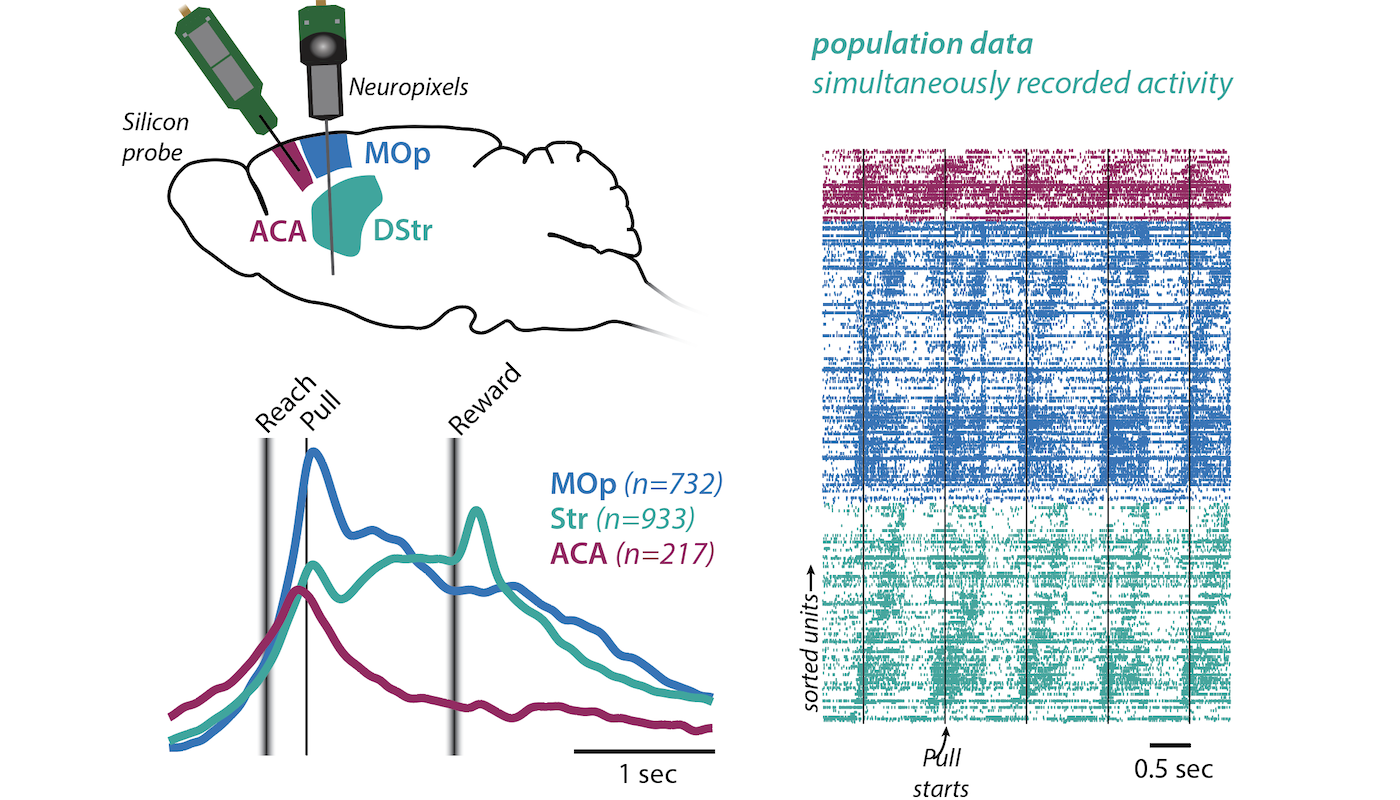
In Conjoint specification of action by neocortex and striatum (Neuron, 2025), Junchol Park and colleagues asked how these two structures shape the details of an action. Quantitative models revealed that small differences between movements provide a powerful test of competing accounts of action control.
Mice learned to reach toward nearby joystick targets and pull with different forces. Simultaneous recordings showed population activity consistent with cortex and striatum jointly specifying continuous movement parameters. Striatal encoding was more widely distributed in space and time, showing that a shared contribution to behavior can be implemented through different population activity patterns.
Shared dynamics across individuals
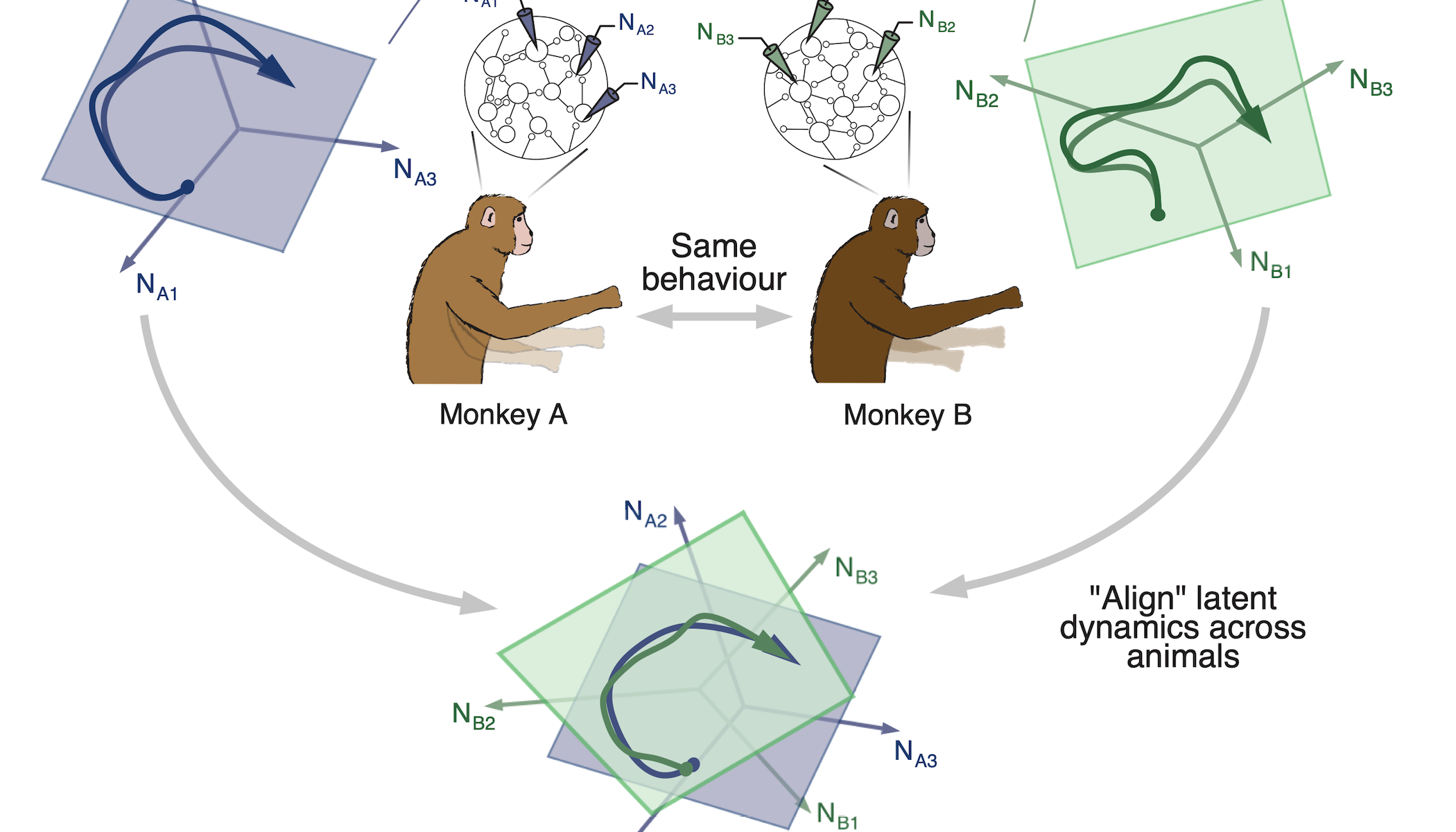
Each brain contains its own circuit wiring. Does each individual therefore arrive at a different neural solution for the same behavior? In Preserved neural dynamics across animals performing similar behaviour (Nature, 2023), Mostafa Safaie, Joanna Chang, and colleagues uncovered common structure beneath differences in individual neurons.
Aligning low-dimensional population activity revealed similar latent dynamics across monkeys performing matched reaches and across mice performing a grasp-and-pull task. This preservation extended to movement preparation, and aligned activity supported decoding across animals. Neural-network controls showed that similar behavior alone does not guarantee shared dynamics, suggesting that common circuit constraints help shape the neural solutions.
Conserved computations across species
Our follow-up collaboration with Matthew Perich extends the comparison across evolution. In Evolutionarily conserved neural dynamics across mice, monkeys, and humans (bioRxiv preprint, 2026), Olivier Codol, Margaux Asclipe, and colleagues compared motor cortical population activity during reaching and object manipulation.
The study reports conserved movement-related dynamics across these species, while differences in behavioral output appear in the geometry of neural trajectories. Comparisons with other brain regions and with movement preparation, together with neural-network models, support the idea that shared circuit constraints preserve aspects of motor computation across very different bodies and behavioral repertoires.
Learning predictive control from subcortical demonstration
Jason Keller and colleagues study how cortex learns to control the innate hindlimb extensions used in jumping. In Cortical control of innate behavior from subcortical demonstration (bioRxiv preprint, 2025), head-fixed mice quickly extended their hindlimbs to stop cold air, then learned within tens of trials to use a predictive cue to avoid it.
Inhibiting rostral cortex prevented anticipatory avoidance while sparing reactive extensions. Mice could also learn covertly before successfully expressing cortical avoidance. These results support a dynamic organization in which control shifts between cortical and subcortical circuits, and suggest that subcortical movements provide demonstrations from which cortex learns predictive control.

From population patterns to circuit mechanisms
Together, these studies motivate our next questions: which circuit properties constrain shared dynamics, how do distinct brain regions coordinate their contributions to a movement, and how does learning recruit existing motor patterns for new goals? Connecting population activity to causal circuit mechanisms is central to understanding how flexible action emerges.