A naive mouse can localize a hidden target in a handful of trials, or match its choices to the best of many options within minutes — far faster than our best models predict. We study how the brain, the body, and the structure of behavior itself make such rapid, flexible learning possible.
Our work combines quantitative behavior, large-scale neural recordings, and cell-type-specific perturbations to ask how animals learn to act purposefully, adapt on the fly, and improve with remarkable efficiency.
Flexible, purposive action
Motor skill is not only about executing a movement quickly and precisely — it is also about the flexibility to reach a goal across a range of vigor (amplitude and speed). That flexibility is an essential, and often overlooked, aspect of skill.
Several lines of evidence implicate the basal ganglia in the purposive control of movement vigor. Using precise joystick paradigms in mice, we found that dopamine-dependent plasticity lets specific basal-ganglia cell types exert a bidirectional, opponent control over vigor — and that its loss, in a model of Parkinson's disease, profoundly saps movement.
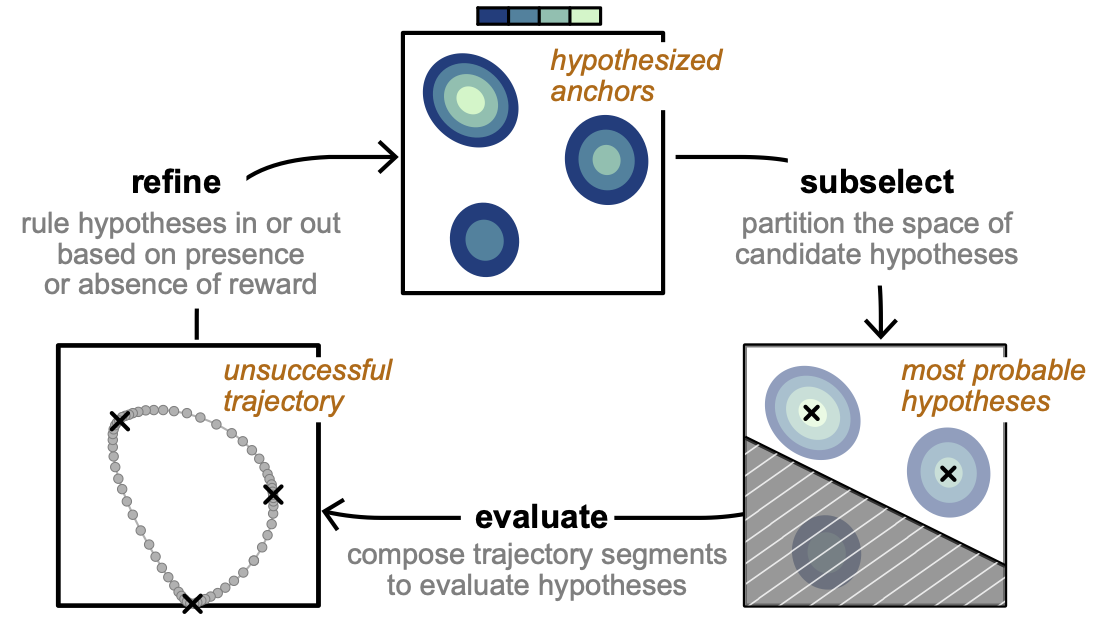
The structure of behavior accelerates learning
When mice explore, they do not move at random: their paths are built from smooth segments joined at reusable “anchor points.” We found that an agent which composes trajectories from such anchors — refining them by Bayesian inference and active sampling — can localize a hidden target within tens of trials, matching the speed and structure of real mice, and even explaining how they avoid obstacles and adapt to moved targets.
The same theme — that behavioral structure makes learning efficient — runs through our foraging work, where mice rapidly learn to match their choices across many options spread across space.
Projects for students
We pair simultaneous, large-scale neural recordings from multiple forebrain areas with optogenetic tools to identify and perturb specific cell types, revealing how they implement distinct aspects of descending control.

Over many summers, undergraduates in the lab have piloted diverse tasks for studying how goal-directed skills are executed and how flexible actions adapt to changing demands — often building new hardware with Janelia Experimental Technology. Interested? Get in touch.
Neuron · 2026
Composing trajectories for rapid inference of navigational goals